

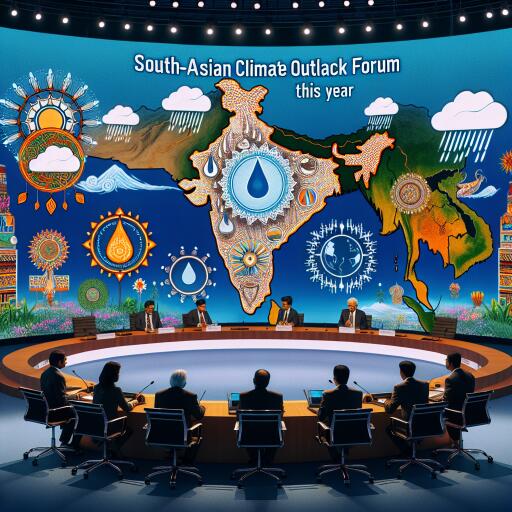
South Asian Climate Outlook Forum Corroborates IMD Outlook of Above-Normal Monsoon for India This Year
The anticipation builds as the South Asian Climate Outlook Forum (SASCOF) unveils its forecasts for this year’s monsoon season. As affirmed in its recent session, the projections back the India Meteorological Department’s (IMD) earlier forecast for an above-normal monsoon across most parts of South Asia, with only a few regions expecting deviations.
As the seasonal climate outlook for the June to September South-West monsoon period was unveiled, predictions hinted at abundant rainfall across the subcontinent. However, certain areas like Tamil Nadu, Jammu & Kashmir, Ladakh-Leh, and parts of North-East India may not witness the same abundance. The analysis indicates that rainfall may diverge from the norm in these locales.
The expansive reach of this optimistic forecast extends beyond India’s borders. Neighboring countries such as Pakistan and Nepal, along with regions like southern Afghanistan and the northern and eastern areas of Sri Lanka, are projected to receive above-normal precipitation. Conversely, other areas will likely align with climatological probabilities, showing no extraordinary deviation from typical seasonal patterns.
Despite the comforting forecasts, past experiences dictate caution. Last year, similar patterns of above-normal rainfall were observed across most of South Asia. However, unexpected below-normal precipitation challenged predictions, especially along the Himalayan foothills and certain southern regions. The complexities of climate systems necessitate continuous observation and updates for effective preparedness.
This year’s collective climate outlook is a product of collaborative efforts among meteorological and hydrological services from nine South Asian nations. Supported by global climate experts, the process integrates a myriad of influences from prevailing global conditions to nation-specific forecasts, along with insights from diverse international climate forecasting organizations.
The enigmatic El Niño Southern Oscillation (ENSO) phenomenon remains a focal point of these forecasts. With current conditions hovering in a neutral state, predictions suggest this neutrality may persist through the monsoon season. The ENSO phenomenon holds significance due to its capacity to influence year-to-year monsoon variability in South Asia.
Furthermore, regional climate dynamics such as the Indian Ocean Dipole (IOD) can sway monsoon outcomes. Presently, neutral IOD conditions persist, and global model forecasts expect them to continue. The IOD’s potential impact has traditionally mirrored that of ENSO, with its positive and negative phases correlating with stronger and weaker monsoon seasons, respectively.
While optimism prevails, a degree of uncertainty lingers due to the inherent unpredictability of global models during the spring transition, known as the ‘spring barrier.’ Other regional and global climate influencers, along with intra-seasonal dynamics, can also affect seasonal weather patterns. Continuous monitoring and adaptive strategies remain essential for navigating these challenges.
As South Asian countries prepare to embrace the upcoming monsoon, the regional collaboration, coupled with advanced forecasting techniques, aims to guide strategic planning and risk management. These efforts underscore the critical role of climate services in safeguarding communities and ensuring resilience against climate variability.
The journey through this year’s monsoon season will undoubtedly serve as a testament to the sophistication of current forecasting capabilities and the unyielding spirit of collaboration in addressing the intricacies of our planet’s climate.



Leave a Reply