

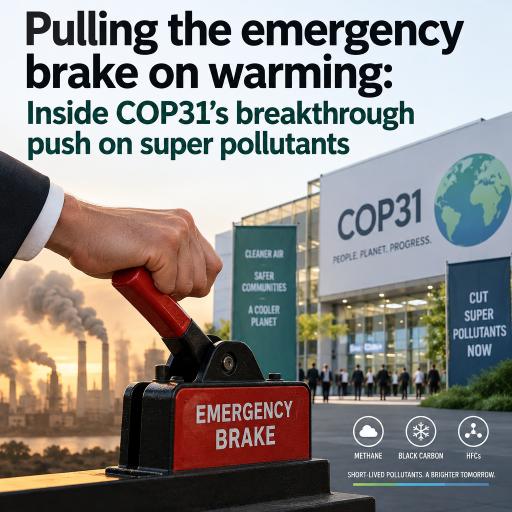
Pulling the emergency brake on warming: Inside COP31’s breakthrough push on super pollutants
As formal negotiations at COP31 in Antalya struggled to advance, a more practical climate agenda gained momentum beyond the main negotiating halls. Governments, scientists, financial institutions and campaigners focused on rapidly reducing “super pollutants” capable of driving intense warming over relatively short periods.
The group includes methane, black carbon, hydrofluorocarbons, ground-level ozone and nitrous oxide. Although carbon dioxide remains the principal cause of long-term climate change, cutting these pollutants could produce faster results while the world undertakes the slower transformation away from fossil fuels.
With the 1.5°C warming threshold expected to be crossed around 2030, supporters described this strategy as an emergency brake. It cannot replace deep carbon dioxide reductions, but it could limit peak warming, reduce pressure on vulnerable ecosystems and buy time for communities facing escalating climate risks.
Soot emerges as a major target
Methane has traditionally received the most attention, but COP31 placed unusual emphasis on black carbon, commonly known as soot. Produced by diesel engines, open waste burning, wildfires, traditional cooking and other forms of incomplete combustion, black carbon both warms the atmosphere and damages human health.
The pollutant is particularly dangerous in mountain and polar regions. When soot settles on snow and ice, it darkens the surface, increases heat absorption and accelerates melting. Countries affected by Himalayan glacier loss urged faster action, warning that retreating ice threatens water supplies, agriculture and communities exposed to floods and landslides.
Mexico, Panama and Cambodia joined an international network dedicated to reducing black carbon, bringing its membership to 12 countries. Their plans reflect different national challenges. Mexico is aiming to cut soot emissions by 51% by 2030. Panama is prioritising the replacement of ageing heavy-duty vehicles, while Cambodia is strengthening its response to wildfires intensified by extreme heat and El Niño conditions.
Cleaner air brings large economic returns
The argument for action is increasingly economic as well as environmental. Analysis presented in Antalya examined 25 established measures across transport, energy, agriculture, cooling and waste. For every dollar invested, these interventions could generate about four dollars in direct market returns and as much as 15 dollars in wider social benefits.
Those gains include lower medical spending, fewer premature deaths, improved worker productivity, stronger crop yields and reduced damage from extreme weather. Health improvements alone could be worth approximately $10 trillion by 2040, while the combined benefits may add the equivalent of 4.5% of global economic output by mid-century.
Methane offers some of the cheapest opportunities. Existing equipment and operating practices could eliminate at least three-quarters of emissions from fossil fuel production, often at little or no net cost. Captured gas can sometimes be sold, allowing companies to recover the expense of detecting and repairing leaks.
Satellite monitoring and rapid-response inspections are already identifying major methane releases that previously went unnoticed. Repairs completed through these systems have delivered an estimated climate benefit comparable to removing 26 million cars from roads for one year. Programs operating across 45 countries are also expected to prevent 11 million tonnes of methane emissions while improving conditions for more than 160 million people.
Finance remains the central obstacle
Developing countries argued that proven solutions will not spread without affordable finance, technical expertise and stronger coordination between ministries responsible for health, energy, agriculture, transport and the environment. Small island states face an especially difficult combination of severe climate exposure and limited public budgets.
COP31 produced several new funding commitments. Philanthropic organisations pledged more than $480 million for methane and other non-carbon-dioxide greenhouse gases. A further $25 million was committed to expand a country-level accelerator for super-pollutant action to 14 nations. Several governments also announced fresh financial support.
Public funding alone, however, will not be sufficient. Development banks and climate funds are exploring ways to reduce investment risks, improve national institutions and incorporate super-pollutant targets into countries’ climate plans and transparency reports.
Budgeting rules may also need reform. Cleaner air can reduce hospital admissions, raise agricultural production and improve labour productivity, yet these benefits are rarely credited to pollution-control programs. Recognising those savings would make measures such as cleaner buses, better waste systems, efficient cooling and methane capture appear less like costs and more like long-term investments.
A faster route to measurable progress
The push in Antalya reframed super pollutants as a central part of climate policy rather than a secondary environmental issue. Their reduction offers something increasingly scarce in global climate action: measurable benefits within years rather than decades.
Success will still depend on implementation. Voluntary pledges must become enforceable policies, financed projects and verified emissions cuts. But for countries seeking cleaner air, healthier populations and immediate protection from warming, tackling super pollutants may be one of the quickest ways to deliver all three.



Leave a Reply