

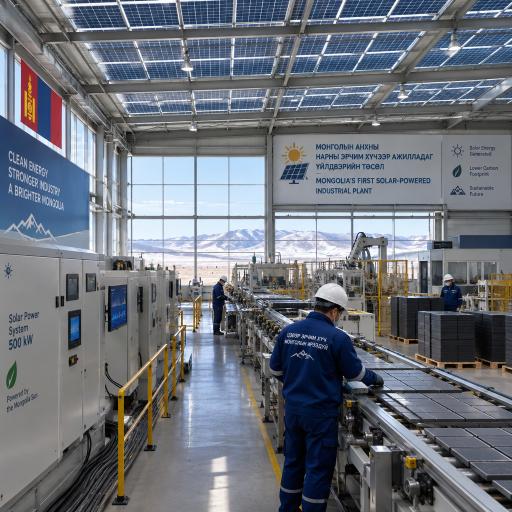
Inside Mongolia’s First Solar-Powered Industrial Plant
In western Mongolia, a cement factory is testing how renewable electricity can reduce the environmental and financial pressures associated with heavy industry.
Khovd Eco Cement, operating in Khovd aimag since 2022, has built an 8-megawatt solar power facility to supply part of its electricity. The project makes it Mongolia’s first industrial plant to be powered partly by renewable energy and could offer a model for other energy-intensive businesses.
Solar power for cement production
The company aims to cover between 50% and 60% of its annual electricity consumption with solar energy. This could lower operating costs while easing demand on the western region’s power system, where industrial expansion can place additional strain on available generation and transmission infrastructure.
A battery energy storage system is also planned. By storing electricity produced during sunny periods, the facility would be able to use more of its solar output when generation falls or factory demand rises. The combination of solar panels and battery storage is expected to support more stable operations and create room for increased construction-material production.
One issue remains unresolved: how the plant can supply surplus electricity to the grid. Company managers have called for the necessary technical and regulatory arrangements to be completed, allowing excess solar generation to serve other consumers rather than going unused.
A regional manufacturing hub
The factory can produce approximately 400,000 tonnes of cement each year. Its primary market includes Mongolia’s five western aimags, while shipments also reach Bayankhongor, Uvurkhangai and Ulaanbaatar.
The plant has additionally begun exporting cement to Russia. Its management is seeking to raise annual exports to 100,000 tonnes and gain wider access to Eurasian markets. Such growth would expand Mongolia’s industrial exports, although greater production will also make efficient energy use and emissions management increasingly important.
Employment beyond the factory gates
More than 350 people work directly at the site. The company estimates that another 3,000 livelihoods are supported through purchases of goods and services from regional herders, farmers and small and medium-sized enterprises.
This local supply chain gives the project a broader role in Khovd’s economy. It also illustrates how decentralized renewable power can support industrial activity in regions far from Mongolia’s largest urban and manufacturing centers.
Government attention
Prime Minister Uchral Nyam-Osor reviewed the facility during a working visit to Khovd aimag. Following discussions with plant representatives, relevant officials were instructed to address the company’s operational and grid-integration challenges in accordance with existing regulations.
The factory’s next phase will be closely watched. If its solar and storage systems deliver the expected savings while reducing pressure on the regional grid, Khovd Eco Cement could become an important case study for cleaner industrial development in Mongolia. Cement remains a carbon-intensive product, but replacing conventional electricity with renewable power is a practical step toward lowering the sector’s overall environmental footprint.



Leave a Reply