

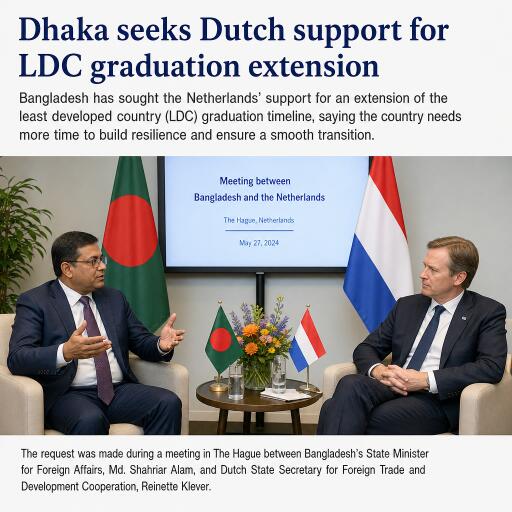
Dhaka seeks Dutch support for LDC graduation extension
Bangladesh has asked the Netherlands to back an extension of its transition out of Least Developed Country status and to help accelerate progress toward a Bangladesh–European Union free trade agreement, as global headwinds and climate pressures complicate its development pathway.
The appeal came during talks in Dhaka between State Minister for Foreign Affairs Humaiun Kobir and the Netherlands’ Minister for Foreign Trade and Development Cooperation, Sjoerd Sjoerdsma. The discussion underscored a shared interest in safeguarding economic momentum while bolstering climate resilience—an imperative for a delta nation on the frontlines of sea-level rise and extreme weather.
Why the timing matters
Graduation from the LDC category is a milestone, but it also brings the phaseout of some trade preferences and concessional support. Dhaka argued that an extended transition would allow time to cushion external shocks, modernize industries, and invest in climate adaptation without derailing job creation or export growth. Officials also stressed that a pathway to a Bangladesh–EU FTA could provide a longer-term anchor for market access and investment certainty, especially as supply chains reset in response to geopolitical and environmental risks.
Both sides noted fresh political mandates in their respective capitals as of February 2026, framing this period as an opening to deepen cooperation and align strategies for sustainable growth.
Water, deltas, and climate resilience at the core
The talks placed water security and climate adaptation at the center of the partnership. The Netherlands—the world’s foremost delta manager—has long supported Bangladesh in river basin planning, flood risk reduction, and urban water governance. The meeting reviewed ongoing collaboration and identified scope to expand technical work on delta management, canal rehabilitation, and climate-ready infrastructure. This includes measures to counter salinity intrusion, enhance drainage, and manage sediment in an increasingly volatile monsoon system.
Dhaka emphasized that water management remains a top priority for Prime Minister Tarique Rahman, citing the intensifying impacts of climate change across low-lying districts. With rising seas and cyclones threatening lives, livelihoods, and export hubs, Bangladesh framed resilient waterways and coastlines as foundational to its development strategy—and as essential buffers during LDC graduation.
Trade and sectoral ties: from shipyards to semiconductors
Beyond water, the two governments mapped out a broader economic agenda. They pointed to shipbuilding and maritime infrastructure as ready channels for Dutch technology and investment, leveraging the Netherlands’ expertise in port efficiency, dredging, and vessel design. Textiles—Bangladesh’s flagship export—featured prominently, with Dhaka seeking continued Dutch support to improve compliance, energy efficiency, and circularity in apparel supply chains.
The dialogue also touched on the emerging semiconductor sector and the potential to attract niche manufacturing and testing operations, particularly where clean energy inputs and water stewardship can create a competitive edge. In agriculture, both sides highlighted the importance of climate-smart value chains and cold storage to reduce post-harvest losses and stabilize prices under erratic weather patterns.
The Dutch side flagged a recent maritime trade mission and potential follow-up visits focused on textiles and water issues, signaling interest in a long-term strategic partnership that could span the next half-century.
FTA momentum and a just transition
Officials in Dhaka framed an EU trade deal as a pillar of a “just transition” from LDC status—one that keeps factories running, encourages cleaner production, and funds climate resilience. While details remain to be negotiated, they urged Dutch support within the EU to keep talks moving, noting that predictable market access and technology transfer would help Bangladesh climb the value chain while meeting higher environmental and labor standards.
Regional stability and multilateral cooperation
The meeting also addressed regional humanitarian pressures, including the protracted Rohingya crisis, with both sides underscoring the need for sustained international engagement toward a durable solution. Beyond the region, they exchanged views on migration governance, reform of the United Nations system, and cooperation across multilateral platforms—particularly relevant as Bangladesh prepares to preside over the 81st session of the UN General Assembly.
What to watch next
- Whether EU capitals, with Dutch support, coalesce around an extended LDC transition for Bangladesh that safeguards hard-won social gains while backing climate adaptation.
- Progress on a Bangladesh–EU FTA roadmap, including provisions on green industrial upgrades, circularity in textiles, and resilient supply chains.
- Scaling up Dutch-Bangladesh water projects that integrate flood control, urban drainage, and nature-based solutions across the delta.
- Concrete steps to expand cooperation in maritime industries, agri-cold chains, and semiconductor niches, aligned with low-carbon energy and resource efficiency.
For Bangladesh, the path forward hinges on balancing trade competitiveness with deep adaptation. For the Netherlands, it is a chance to demonstrate how climate-informed commerce and delta stewardship can underpin a fairer, more resilient global economy. Both sides signaled they are ready to do the difficult work in between.



Leave a Reply