

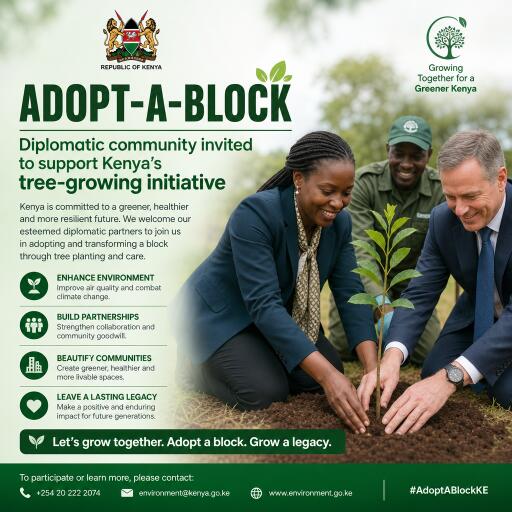
Adopt-a-block: Diplomatic community invited to support Kenya’s tree-growing initiative
Kenya is extending an open invitation to embassies, United Nations agencies, international organisations and development partners to help accelerate a nationwide tree-growing drive through a new Adopt-a-Block initiative. The effort, coordinated by the State Department for Foreign Affairs, is designed to rally global partners behind locally led landscape restoration, boost tree cover and turn climate pledges into visible, long-term gains on the ground.
At its core, Adopt-a-Block enables institutions to select and support defined parcels of degraded land—financially or in kind—covering the full cycle from nursery seedlings and site preparation to planting and multi-year maintenance. By structuring participation in clear, measurable blocks, the programme aims to strengthen accountability, foster collaboration and deepen international engagement in Kenya’s green transition.
A catalyst for Kenya’s 15-billion-tree agenda
The initiative dovetails with the national plan to grow 15 billion trees by 2032, lift tree cover to 30 percent and rehabilitate 10.6 million hectares of degraded landscapes. The State Department for Foreign Affairs has been tasked with a share of this mission and allocated 240 hectares (about 593 acres) across Kajiado, Kiambu, Machakos, Kirinyaga and Tharaka Nithi counties for restoration.
As part of its contribution to the national effort, the department has set an annual target of planting five million trees. The Adopt-a-Block effort is expected to mobilise the resources, partnerships and stewardship needed to meet that goal while supporting jobs in nurseries, land preparation, planting teams and follow-up maintenance—critical steps to ensure tree survival beyond the initial planting season.
How adoption works
To encourage participation from a wide range of partners, the 240-hectare area has been subdivided into blocks of differing sizes. Participating organisations may adopt a block and support it through direct funding or in-kind contributions such as seedlings, logistics, equipment and maintenance services. Each adopted block will acknowledge the partner’s contribution by name, providing a visible marker of collective action.
Proposed adoption packages include:
- 5 acres for Sh1 million, supporting an estimated 5,000 trees
- 10 acres for Sh2 million, supporting an estimated 10,000 trees
- 15 acres for Sh3 million, supporting an estimated 15,000 trees
- 20 acres for Sh4 million, supporting an estimated 20,000 trees
Overall, the department is seeking Sh118.6 million from international partners to finance seedlings, site preparation, logistics, planting and ongoing care. While the funding targets are clear, in-kind support is equally encouraged to bolster on-the-ground capacity and technical expertise.
From pledges to planted forests
Tree growing succeeds when it goes beyond symbolic plantings to long-term stewardship. The Adopt-a-Block structure is intended to hardwire that approach: matching resources to specific landscapes, tracking progress block by block and providing for maintenance to improve survival rates. By doing so, it creates a transparent pathway for partners to demonstrate impact—turning high-level climate and biodiversity commitments into living canopies and healthier soils.
The ecological dividends are wide-ranging. Expanding tree cover can help stabilise water catchments, reduce erosion, and buffer communities against climate extremes. Thoughtful species selection supports biodiversity and pollinators, while restored soils and growing trees act as carbon sinks. Local economies benefit too, through seedling production, transport and the skilled work of site preparation and aftercare.
A partnership model built for scale
Kenya’s pitch to the diplomatic community is as much about partnership design as it is about trees. By offering clear tiers of participation and naming recognition, the initiative encourages collaboration across embassies, multilateral agencies, development banks and non-governmental organisations. It also opens doors for technical exchanges—ranging from climate-smart forestry practices to monitoring technologies that track growth, survival and carbon benefits over time.
Crucially, the programme highlights nationally led action, with Kenyan institutions setting targets and coordinating delivery while international partners provide resources and know-how. This alignment supports durable, country-owned results and can serve as a template for other landscape restoration efforts in the region.
Next steps
With land already identified across five counties and packages defined, the initiative is ready to move from planning to planting. Interested missions and agencies can select block sizes aligned with their capacities and priorities, focusing on the full life cycle of trees—from seed to sapling to self-sustaining forest stands.
In a decade that demands practical climate solutions, Adopt-a-Block offers a straightforward, trackable and locally anchored way to help restore degraded land at scale. For partners seeking to connect global goals with real outcomes, the path forward is clearly mapped—one block, and one growing forest, at a time.



Leave a Reply