

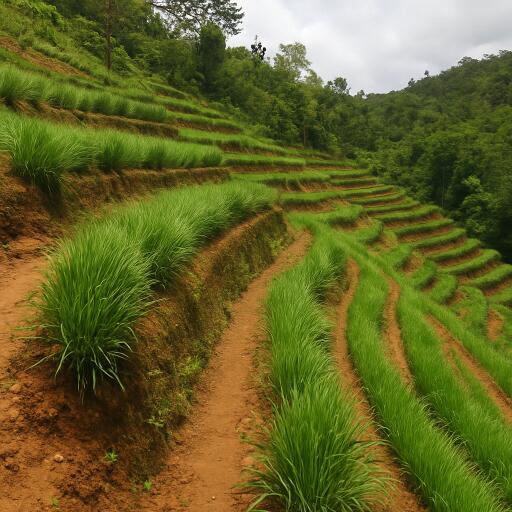
Vetiver Grass Terraces Slash Fertilizer Runoff in Sri Lanka’s Steep Slopes
On Sri Lanka’s rain-soaked tea hills, fertilizer can disappear almost as quickly as it is applied. When monsoon storms hit steep plantations, nutrient-rich runoff rushes downhill, stripping fields of valuable inputs and sending pollution toward streams and reservoirs below. New research from a highland tea estate shows that a low-tech solution can make a major difference: stone terraces paired with strips of vetiver grass sharply reduce both runoff and fertilizer loss.
The field trial was carried out in the central highlands on steep tea land with slopes ranging from 60 to 72 percent. These are difficult growing conditions even in the best seasons. The area receives intense rainfall, and the soils are acidic and already short on key nutrients. Organic carbon and plant-available minerals were below desirable levels before the experiment began, meaning every kilogram lost in flowing water carries a real economic penalty for growers.
To test how well different conservation systems work, researchers set up a series of runoff plots in a tea field and compared four approaches: tea with no protective structure, a level stone terrace, a raised terrace wall, and a stone terrace reinforced with vetiver grass planted along its inner edge. Over more than a year of monitoring, the site was hit by nearly 6,000 millimeters of rain, providing an ideal stress test for erosion control.
The results were striking. Plots with no protection lost the most water by far. Stone terraces alone cut runoff substantially, terrace walls performed even better, and the combination of stone terraces with vetiver delivered the strongest overall reduction. That system reduced runoff volume by about 80 percent compared with unprotected tea land.
Because less water escaped the plots, less dissolved fertilizer escaped with it. The terrace-and-vetiver treatment reduced dissolved nitrogen losses by roughly 78 percent, phosphorus losses by around 80 percent, and potassium losses by about 86 percent compared with fields without conservation measures.
The science behind the improvement is straightforward. Stone terraces interrupt the downhill movement of water, slowing its speed and allowing more time for infiltration into the soil. Vetiver adds a living barrier. Its dense growth acts like a filter, trapping sediment and helping stabilize the terrace edge. Together, the hard structure and the plant hedge create a far more effective defense than exposed slope surfaces left to take the full force of rainfall.
One of the more interesting findings is that nutrient concentrations in runoff water did not always change very much between treatments. Instead, the decisive factor was the total amount of water leaving the field. If the runoff volume drops sharply, the total nutrient export falls with it. In other words, conservation works not necessarily by changing the chemistry of runoff, but by preventing so much runoff from forming in the first place.
Nitrogen losses were notably lower where terraces and vetiver were installed. This matters because nitrogen is one of the most expensive and agronomically important fertilizer inputs in tea cultivation. Potassium, however, emerged as an even bigger hidden loss in untreated plots. While it often receives less public attention than nitrogen or phosphorus, potassium is essential for plant health, and the study found that it was heavily depleted when slopes were left unprotected. The terrace-and-vetiver setup held on to far more of this nutrient than the control plots did.
Phosphorus behaved somewhat differently. Because it tends to bind tightly to acidic soils, dissolved phosphorus losses were smaller relative to the amount applied. Even so, the protected plots still showed lower losses than unprotected land, reinforcing the value of barriers that curb runoff at the source.
For tea growers, the implications are practical as much as environmental. Fertilizer is a costly input, and repeated losses to runoff raise production expenses while reducing field efficiency. A system that keeps nutrients on the slope can improve returns without relying on advanced machinery or expensive chemical interventions. Vetiver is already familiar in many tropical farming systems, and stone terraces are a long-established form of land shaping. What this study adds is clear field evidence that the two together can dramatically improve nutrient retention under extreme rainfall conditions.
The broader environmental payoff is also significant. Nutrients washed from plantations do not simply vanish; they move into waterways, where they can contribute to declining water quality and ecological stress downstream. On steep agricultural land exposed to heavier rains, especially under a changing climate, these off-site effects are likely to become more severe unless landscapes are redesigned to slow and capture water.
That is what makes the Sri Lankan findings so notable. They do not depend on a futuristic technology or a complex management package. Instead, they point to a robust, adaptable method built from physical landscape control and plant-based reinforcement. In steep tea country, where every storm can carry away soil, fertilizer, and profit, a strip of vetiver along a well-built terrace may be one of the simplest tools available for protecting both harvests and watersheds.
As pressure grows on plantation agriculture to become more resilient and less polluting, this kind of approach offers a rare win-win: lower nutrient loss for farmers and cleaner runoff for the ecosystems below.



Leave a Reply