

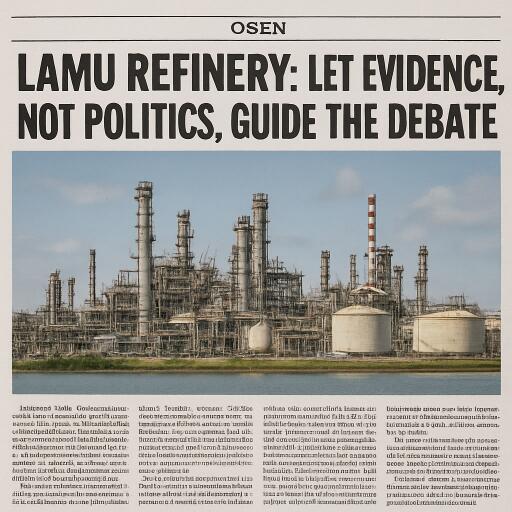
OSEN: Lamu refinery: Let evidence, not politics, guide the debate
Kenya’s proposed mega-refinery in Lamu, backed by Nigerian industrialist Aliko Dangote, has reignited a familiar storm: high-stakes development colliding with election-season theatrics and hard questions about climate, livelihoods, and the law. It is precisely in such moments that sober evidence—not partisan skirmishes—must chart the way forward.
What is actually on the table
The plan, as reported, envisions an offshore-oriented refinery near Lamu with capacity of up to 700,000 barrels per day, underpinned by investment estimated at around Sh2.2 trillion. The site falls within a Special Economic Zone designated years ago to catalyse large-scale industrial projects and logistics. If executed, it would rank among the most consequential energy assets in East Africa, with ripple effects for employment, infrastructure, and regional trade.
The economic promise—and the policy test
Kenya’s unemployment challenge and industrial ambitions are real. A complex like this could stimulate thousands of direct and indirect jobs during construction and operations, anchor ancillary industries from petrochemicals to logistics, and potentially improve energy security. It could also strengthen the balance of payments by substituting imports and generating new export streams—if carefully structured.
Yet big numbers alone can mislead. Policymakers must separate temporary construction booms from durable, diversified employment. Past mega-projects across the continent show that headline job claims can dissolve if local content rules are weak, training inadequate, and supply chains remain import-heavy. Transparent procurement, enforceable local participation targets, and credible skills pipelines matter as much as steel and concrete.
Climate, coastline, and community
Lamu is no ordinary backdrop. Its mangroves, coral reefs, and seagrass beds knit together fisheries, coastal protection, and food security. Heavy industry on this shore raises legitimate concerns: habitat loss, dredging impacts, wastewater and air emissions, increased tanker traffic, and worst-case oil spill scenarios. These are not abstract risks. They demand rigorous, project-specific Environmental and Social Impact Assessments (ESIAs), cumulative impact modelling for the broader bay, and binding mitigation plans aligned with best available techniques.
A credible ESIA must include a full marine baseline, shoreline sensitivity mapping, spill trajectory modelling under seasonal currents, and an air quality plan that eliminates routine flaring and minimises sulphur and particulate emissions. It must also quantify greenhouse gases across the refinery’s lifecycle and articulate a carbon management pathway consistent with Kenya’s climate commitments.
Equally vital is a social impact roadmap: thorough public participation in the languages people speak, fisher livelihood assessments, cultural heritage protection, fair compensation where required, and community benefit agreements with measurable, enforceable targets.
Due process is not a box-tick
Some argue that since the area was long ago gazetted as a Special Economic Zone, fresh consultations are redundant. They are not. SEZ designation sets a development framework; it does not replace project-level engagement and consent. Kenya’s constitution and environmental laws require meaningful participation—documented meetings, reasoned responses to public input, and open access to the studies that shape approvals. Anything less erodes trust before ground is even broken.
Keep politics in its lane
Two forms of politicisation threaten clear thinking. One casts the refinery as a simplistic campaign trophy or cudgel. The other reflexively rejects large projects—particularly those financed outside traditional corridors—on principle. Both shortcuts lead us away from good policy. Around the world, climate discourse has been twisted by polarisation and misinformation, from trivialising renewable energy’s progress to treating fossil expansion as a zero-cost shortcut to growth. Kenya should reject those easy narratives and insist on facts.
The evidence that should decide
- Full ESIA in the public domain, including peer-reviewed marine and air quality studies, with clear mitigation and monitoring plans.
- Independent spill risk analysis, emergency response capacity, and a ring-fenced fund for rapid remediation.
- Transparent jobs and local content plan distinguishing temporary and permanent roles, with training pipelines and gender targets.
- Greenhouse gas inventory and a binding emissions reduction plan: zero routine flaring, high-efficiency equipment, electrification where feasible, and credible offsets only after reducing at source.
- Clear benefit-sharing with Lamu communities—royalties or levies that translate into visible services, fisheries restoration funds, and coastal protection investments.
- Shipping and port standards that cap sulphur, require double-hulled vessels, and establish real-time vessel tracking and pilotage.
- Continuous environmental monitoring open to the public—water quality, biodiversity indices, air pollutants, and greenhouse gases—validated by independent auditors.
- Transparent financing and decommissioning plans to avoid stranded liabilities when the facility’s life ends.
A pragmatic path forward
If the evidence supports it, a conditional greenlight could proceed in stages: limited early works tied to strict environmental prerequisites, followed by phased expansion only after targets are independently verified. Where red flags persist—particularly around critical habitats—no-go zones must be respected, with design changes or offsets that demonstrably achieve net biodiversity gain, not paper promises.
Kenya can set a new bar for industrial governance by requiring cutting-edge controls: vapour recovery, wastewater recycling, sulphur recovery, leak detection and repair, and real-time emissions disclosure. It can also stipulate local fisher compensation tied to monitored catch trends and invest in mangrove restoration as natural infrastructure for storm protection and carbon storage.
Above all, transparency is the antidote to suspicion. Publish the studies. Track the promises. Invite scrutiny. Where the numbers don’t add up—economically, socially, or ecologically—say so, and change course.
The Lamu refinery could become a case study in evidence-led development—or a cautionary tale of politics overwhelming prudence. The choice should not hinge on campaign calendars or ideological reflexes. It should rest on verifiable science, lawful process, and a clear-eyed accounting of costs and benefits for the people who call Lamu, and Kenya, home.



Leave a Reply