

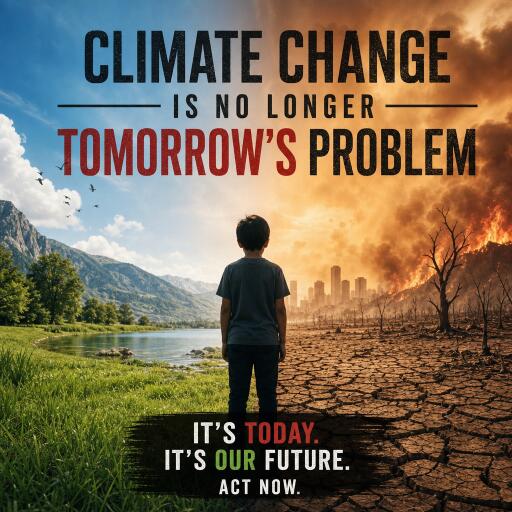
Climate change is no longer tomorrow’s problem
For years, the climate crisis was framed as a distant threat. In Nigeria, that mirage has vanished. Rains arrive off-season. Floodwaters linger for weeks. Harvests shrink. Food prices jump. Roads vanish beneath torrents, power lines fail, shops close, and families relocate from places that no longer feel livable. Climate change is not knocking on the door; it has moved in—and it is rearranging the household economy.
The most costly misunderstanding is to treat climate change as only an environmental issue. It is a pocketbook issue, a productivity issue, and a public safety issue. It shapes how much a farmer earns, how high a family’s grocery bill climbs, what manufacturers spend getting goods to market, how banks price risk, what insurers cover, and how much government must pour into rebuilding the same bridges and schools—again and again.
The hidden tax of a hotter, wilder climate
- Crop losses ripple into higher food prices.
- Washed-out roads raise transport costs and delay supplies.
- Flooded markets destroy inventory and thin profit margins.
- Extreme heat lowers worker productivity and increases business costs.
- Repeated infrastructure damage diverts scarce public funds from clinics, classrooms and power to repairs.
This is how climate risk seeps into the economy—quietly, then abruptly. Countries with slimmer fiscal buffers feel the shocks most. So the question for Nigeria should not only be how much global temperatures rise, but what each additional shock does to household income, business profitability and public finances. That is the metric to track.
When weather stress becomes social stress
Environmental pressure often magnifies existing tensions. Scarcer grazing land breeds competition. Declining soil fertility squeezes livelihoods. Floods force people to move. As populations shift, communities once separated by distance must suddenly share land, water, markets and services. A drought is a weather event; a drought that erases incomes becomes an economic event. Economic strain can drive migration. Migration can escalate into political friction—and, under the wrong conditions, a security crisis.
This is why early warning must be more than a forecast—it must be a trigger for action. If drought risk is mounting, farmers and pastoralists should not discover it when crops fail and cattle weaken. If rivers will breach their banks, emergency teams and supplies must move before homes are underwater. The gap between preparation and reaction is counted in lives saved and billions of naira protected.
Measure the risk to manage it
What would a 1-in-50-year flood cost Lagos in lost output and damaged assets? How would a prolonged drought hit Kano’s food systems? What does coastal surge mean for the Niger Delta’s communities and pipelines? How much agricultural value, public infrastructure, bank lending, insurance exposure and employment sits in harm’s way? These cannot be academic questions. They belong in boardrooms, ministries, credit committees and investment plans. Ignoring climate risk is not pragmatism; it is mispricing.
Adaptation is a market—if we choose to build it
Every major problem creates demand for solutions. Nigeria needs urban drainage and floodplain management; climate-resilient roads, bridges and schools; drought-tolerant seeds and precision irrigation; better water storage; early warning systems; catastrophe risk modelling; crop and flood insurance; reliable data; distributed energy and more resilient supply chains. This is one of the largest new markets of our time. The open question is whether Nigerian entrepreneurs and investors will lead—or whether we will import solutions later at a premium.
The tools exist. Decisions lag.
Satellite rainfall and soil-moisture data are updated daily. Combined with machine learning, they can map drought or flood risk at ward level, not just by state. Artificial intelligence can translate a rainfall anomaly into estimates of affected households, livestock and road kilometres—fast enough to act. Parametric insurance can pay farmers via mobile money within days of a trigger, without waiting for a damage assessor. Remote sensing, digital soil maps and AI-assisted crop monitoring can help banks and insurers price agricultural risk more accurately, expanding access to credit and coverage for smallholders. None of this replaces local judgment or strong institutions. But it means Nigeria doesn’t have to start from zero. What’s missing is the mandate to deploy these tools consistently, at scale.
Choose your risk model: dependency or ownership
A nation that faces every flood or drought with emergency appeals is stuck in a reactive cycle—slower, costlier and more uncertain. An ownership model looks different: identify the risks, quantify them, price them, insure what can be transferred, fortify what must be protected, relocate what cannot be defended, and pre-fund rapid response. That means contingency budgets, insurance and risk pools that release money quickly enough to prevent shocks from becoming catastrophes. The financial gap becomes a policy choice, not a surprise bill.
The real deadline
Climate change demands more than speeches. It requires institutional memory, high-quality data and disciplined capital allocation. The debate is no longer about whether the climate is changing. The urgent question is whether our institutions can change fast enough to meet it—and whether we will pay the hidden tax of inaction, or invest now to cut the bill later.



Leave a Reply