

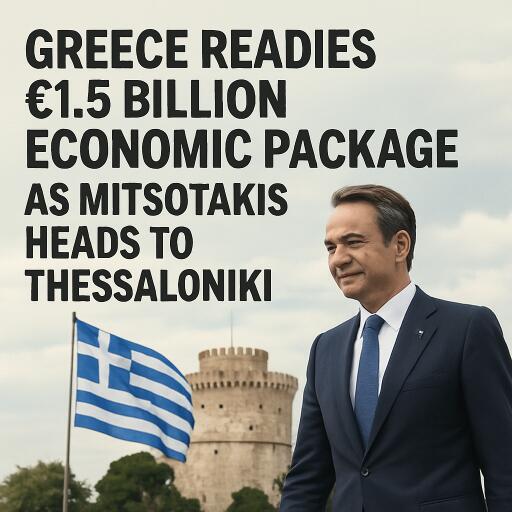
Greece Readies €1.5 Billion Economic Package as Mitsotakis Heads to Thessaloniki
As the Thessaloniki International Fair approaches, the Greek government is assembling a fresh round of relief and reform measures aimed at easing the cost-of-living squeeze, boosting take-home pay, and nudging investment—while keeping a firm grip on the public purse. The core measures carry an estimated fiscal impact of about €1.5 billion in 2027, with additional outlays on energy infrastructure set to push the broader package above €2 billion.
Final tweaks before the flagship speech
Senior officials are locking in the centerpiece policies now, with a handful of choices—especially on housing and energy—expected to be finalized closer to the prime minister’s keynote in Thessaloniki. The political message is calibrated: translate improved public finances into visible gains for households and businesses without undermining the credibility Greece has rebuilt since the debt crisis.
Self-employed tax relief, tied to compliance
One of the most sensitive changes targets the presumptive minimum-income regime for the self-employed. Rather than scrapping it, the government is preparing a carve‑out for those who show consistent, verifiable compliance. Use of digital bookkeeping, e‑invoicing, point‑of‑sale connectivity and timely settlement of tax and social‑insurance dues could all count toward lighter obligations. The system now yields roughly €500 million a year; after adjustments, annual takings could slide to €300–€350 million.
Lighter advance tax prepayments
Another lever under consideration reduces the advance tax that freelancers and companies must prepay for the following fiscal year—a longstanding complaint due to liquidity pressure. A deeper cut for the self‑employed is on the table, with a more gradual easing for corporations. Talk of steeper headline corporate tax cuts or scrapping the annual business levy appears off the agenda for now.
Social contributions and wages
A further 0.5 percentage point reduction in social‑security contributions is planned, with the final split still to be determined: either shared between employers and employees, or directed entirely to workers to maximize net pay. The statutory minimum wage is set for another step up—approaching, and potentially surpassing, €950 a month. Because public‑sector pay is linked to the minimum, the ripple effects would extend beyond private employment. Authorities are also weighing a higher daily ceiling for meal vouchers to bolster disposable income.
Support for retirees
Pensioners are in line for continued November support payments, with options on the table to lift the amount or widen eligibility. Changes are also being studied to the Pensioners’ Solidarity Contribution to smooth out sharp deduction “cliffs” that hit some retirees when crossing specific income thresholds.
Families and the farm economy
For households, additional tax relief is being mapped out with a focus on families with three or more children and income‑tested benefits that scale with family size. A targeted value‑added tax cut on selected baby products has been discussed to lower everyday costs. Farmers, meanwhile, are slated for a separate tax intervention, alongside a push to accelerate subsidy disbursements and stabilize payment flows—an increasingly sensitive issue as producers contend with input costs and climate‑related volatility.
Housing: the biggest unresolved piece
Soaring rents and property prices—especially in Athens and hotspots shaped by tourism and investment demand—have turned housing into one of the thorniest policy areas. A new program modeled on the “My Home” initiative is under review to help younger buyers through subsidized financing. Policymakers are also considering extensions of tax incentives to bring vacant units back to market, encourage longer‑term leases, and spur new residential construction.
Energy investment to anchor the transition
The most capital‑intensive component concerns energy—critical for competitiveness, climate goals, and shielding consumers from price shocks. Leveraging added fiscal flexibility under European rules, the government is preparing to channel more than €1 billion through 2028 into a suite of projects: modernizing electricity distribution and transmission, building energy‑storage capacity, expanding cross‑border and domestic interconnections, accelerating renewables, and upgrading building efficiency.
For a power system increasingly fed by wind and solar, storage and interconnections are the backbone that keep the lights on when the weather doesn’t cooperate. Batteries and other storage solutions can absorb surplus daytime generation and release it during evening peaks, while stronger ties with neighboring grids help balance variability and reduce reliance on costly fossil‑based backup. On the demand side, boosting the energy performance of homes and workplaces cuts bills, lowers emissions, and can free up capacity on the grid—especially during summer heatwaves when cooling loads soar.
Balancing relief, reform, and resilience
The Thessaloniki package is intended as a careful blend of short‑term relief and longer‑term efficiency: easing tax and contribution burdens, nudging wages upward, and targeting vulnerable groups, while aiming investment at the structural upgrades Greece needs for a stable, lower‑carbon economy. The financial contours are largely set; the final stroke will be how Athens sequences the measures to preserve fiscal discipline and sustain momentum on the energy transition.



Leave a Reply