

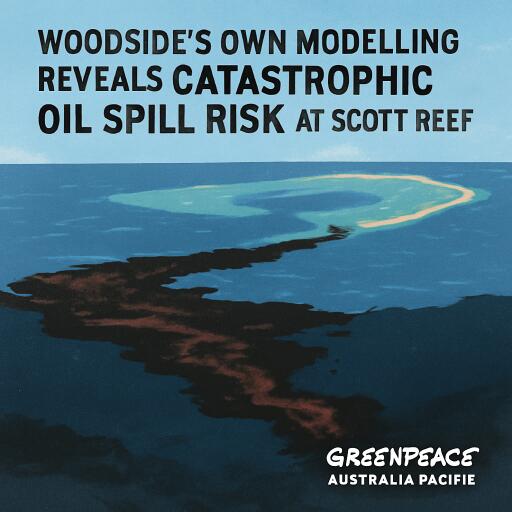
Woodside’s own modelling reveals catastrophic oil spill risk at Scott Reef – Greenpeace Australia Pacific
New scrutiny of environmental assessment material tied to Woodside’s proposed Browse gas project has raised stark warnings about the danger an offshore blowout could pose to Scott Reef and the surrounding seas. The documents indicate that, in a worst-case scenario, a major spill near the reef could become one of the most destructive marine pollution events ever seen in Australian waters.
At the centre of the concern is Scott Reef, a remote and exceptionally rich marine ecosystem off the Kimberley coast. The reef is recognised as Australia’s largest freestanding oceanic reef and has developed over millions of years into a refuge for remarkable biodiversity. Its waters support thousands of marine species, including threatened pygmy blue whales, green sea turtles, dusky sea snakes and extensive coral communities.
The proposed Browse development would involve drilling dozens of wells in the vicinity of the reef. Conservation groups argue that the project would bring long-term industrial pressure to an area that has so far remained relatively intact. Seismic surveys, underwater noise, vessel traffic, artificial lighting and the possibility of pollution are all cited as major threats to wildlife and habitat health.
The greatest alarm, however, comes from spill modelling contained in project documentation. According to the analysis of those materials, the most extreme blowout scenario could release an enormous volume of condensate into the Timor Sea, far beyond the scale of past offshore spills in Australia. Such an event would not remain confined to a single drilling location. Oil and contaminated water could disperse across a vast marine region, with pollution potentially reaching reefs, marine parks and coastal environments over hundreds of kilometres.
The modelling suggests that oil could spread through the water column and drift great distances from the source, threatening a wide arc of ecologically significant habitat. These pathways place not only Scott Reef at risk, but also a broader network of connected marine ecosystems. Sensitive coral formations, turtle migration and nesting areas, whale habitat, feeding grounds for seabirds and culturally important sea country could all be exposed.
Particular concern surrounds the language used in the environmental risk assessments, which describe the possible consequences of a major incident in severe terms. Impacts are characterised as potentially long-lasting and, in some cases, irreversible. For marine scientists and campaigners, that wording underscores the vulnerability of reef systems and offshore wildlife to toxic contamination.
Scott Reef’s importance extends well beyond its striking coral structures. Remote reefs like this serve as biological strongholds, supporting species that rely on clear waters, healthy food webs and relatively low industrial disturbance. Damage to one part of the system can ripple outward, affecting predator-prey relationships, breeding cycles and the resilience of habitats already under stress from warming seas and coral bleaching.
The concern is also geopolitical as well as ecological. A spill of sufficient size in the Timor Sea could move across jurisdictional boundaries, affecting waters used by neighbouring countries and complicating containment and clean-up efforts. Offshore oil pollution is notoriously difficult to control, especially in remote areas where weather, currents and distance from infrastructure can hinder emergency response.
For the Kimberley region, the stakes are especially high. Its coastal and marine environments sustain tourism, fisheries, cultural values and iconic wildlife populations. Pollution washing toward shorelines or into adjacent reef systems could have consequences far beyond the immediate accident site, disrupting livelihoods and damaging habitats that communities have relied on for generations.
The debate comes at a critical time because the Browse proposal has not yet received final approval. That means the warnings laid out in project assessments remain part of an active decision-making process rather than a post-disaster reckoning. Environmental advocates say this gives regulators a rare opportunity: to weigh the full consequences of a potential accident before industrial activity begins.
In conservation terms, Scott Reef represents a test of how much risk governments are willing to accept in one of Australia’s most biologically important marine environments. Supporters of stronger protections argue that when a company’s own modelling points to the possibility of large-scale ecological harm, precaution should prevail.
The broader question reaches beyond one gas project. It speaks to how nations balance fossil fuel expansion against the survival of vulnerable ecosystems in an era of mounting environmental instability. Places like Scott Reef are not easily restored once damaged. Coral growth, species recovery and ecosystem repair can take decades, if recovery is possible at all.
What is now under discussion is not merely a local industrial proposal, but the future of a rare ocean sanctuary. If development proceeds, critics fear the reef could become known not for its extraordinary marine life, but for the scale of the risk imposed upon it. For scientists, conservationists and coastal observers, the warning from the modelling is clear: an accident at Scott Reef could leave a footprint far larger than the drilling site itself.



Leave a Reply