

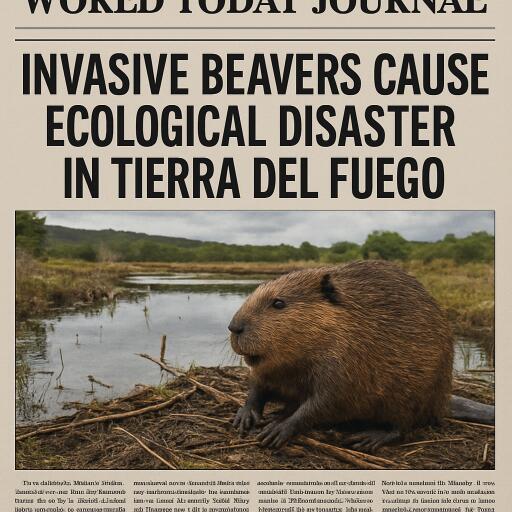
Invasive Beavers Cause Ecological Disaster in Tierra del Fuego – World Today Journal
A wildlife introduction carried out decades ago at the southern tip of South America has grown into one of the region’s most damaging ecological crises. In Tierra del Fuego, a small number of beavers released in the 1940s multiplied across isolated river basins and transformed large areas of native forest, wetlands, and streams. What began as an attempt to create a fur-based industry has instead produced long-lasting environmental disruption and mounting economic losses.
The problem is rooted in the beaver’s engineering behavior. These animals survive by felling trees and building dams that slow rivers and flood surrounding land. In their native northern habitats, many ecosystems evolved alongside this pattern. In Tierra del Fuego, however, the landscape was not prepared for such large-scale alteration. Water backed up behind dams forms ponds that drown native trees, alter soil conditions, and replace flowing channels with stagnant pools.
The contrast between local forests and those in North America is critical. Many of Patagonia’s native trees are poorly adapted to prolonged flooding. Once their roots remain submerged for extended periods, they die, and recovery is slow because these forests take many decades to mature. The result is a haunting landscape of standing dead timber, collapsed streambanks, and expanding wetlands where woodland once stood.
Over time, the damage has spread across tens of thousands of acres. In some valleys, beavers have built chains of dams that step up the terrain, interrupting natural drainage and reshaping entire watersheds. What might seem like isolated ponds from the air often forms a connected network of altered waterways on the ground. This intensifies flooding, changes sediment movement, and fragments habitat for species that depend on cold, fast-moving water.
The ecological consequences go beyond trees. Aquatic systems suffer when water flow slows and oxygen levels decline. Native fish and invertebrates can lose suitable habitat, while changes to temperature and chemistry can ripple through the food web. Wetlands created by the dams may benefit some opportunistic species, but they do so at the expense of the original forest-stream mosaic that defined the region.
Communities also feel the impact in practical ways. Beaver activity can interfere with water supplies, damage culverts and drainage systems, and complicate watershed management. The financial cost is significant, with regional losses estimated in the tens of millions of dollars each year when infrastructure disruption, environmental degradation, and management efforts are taken into account.
The remoteness of Tierra del Fuego makes the situation especially difficult to control. Much of the affected terrain is rugged, sparsely populated, and hard to access by road. That means officials and field teams often depend on aircraft, remote sensing, and satellite imagery to identify active dams and prioritize intervention zones. Rather than trying to eliminate every beaver across the entire island landscape, many campaigns focus on strategic containment and the protection of high-value ecosystems and water resources.
Specialized removal teams work in selected areas where the ecological return is likely to be greatest. Their objective is not only to reduce animal numbers but also to stop dam maintenance, allowing rivers to gradually reestablish their natural courses. In places where beavers have been removed successfully, researchers have observed signs of forest regeneration. Native vegetation can return, although recovery is uneven and often slow, especially where soils and hydrology have been heavily altered.
The history of this invasion offers a stark lesson in ecological risk. Introducing a species into a new environment without predators or natural controls can have consequences that last for generations. In Tierra del Fuego, the beaver became more than an imported mammal; it turned into a force capable of redesigning landscapes at a continental extreme.
Today, the crisis is both a warning and a test of restoration science. Conservationists must balance limited resources, difficult geography, and the stubborn persistence of an animal that is exceptionally effective at changing its environment. While complete eradication remains unlikely in the near term, targeted management has shown that damaged areas are not beyond hope. If interventions continue and sensitive watersheds are protected, parts of Tierra del Fuego may slowly recover from one of the most striking biological invasions in the Southern Hemisphere.



Leave a Reply