

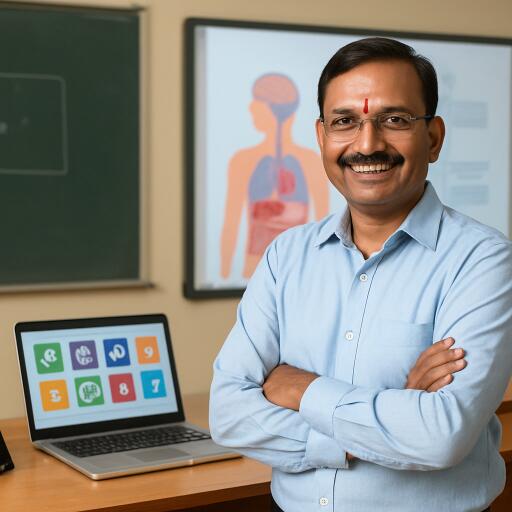
Jhalawar Educator Who Transformed School Into Digital Lab To Get National Teachers’ Awards
A science teacher from Rajasthan’s Jhalawar district is set to receive one of India’s highest recognitions for educators after turning a government school campus into an interactive digital learning space built around ecology and technology.
Divyendu Sen, who teaches biology at Mahatma Gandhi Government School in Pachpahar near Bhawanimandi, has been selected for the National Teachers’ Award and is expected to be honoured by President Droupadi Murmu on September 5. His selection places him among a small group of teachers from Rajasthan and among a limited number of awardees chosen from across the country.
What makes Sen’s work stand out is the way he fused environmental education with simple digital tools. Rather than treating the school grounds as just open space, he helped convert the campus into a living laboratory where trees and plants became teaching resources.
The project involved placing QR codes on around 500 trees and plants across the school campus. When scanned with a smartphone, each code provides information about the species, including its scientific name, uses, and ecological importance. The material was designed to make learning more accessible and engaging for students while also encouraging curiosity about biodiversity.
In a distinctive local touch, the information was also made available in Hadoti and Malvi, two regional dialects familiar to many students and visitors. Audio playback was added as well, turning the system into more than a digital label. Instead of only reading text, users can hear the descriptions spoken aloud, making the experience more inclusive and interactive.
The audio element was developed with contributions from members of the school community, including students and teachers. This gave the initiative a collaborative character and helped strengthen student participation in the learning process. By hearing familiar voices explain plant life and ecological value, the school environment itself became part of the classroom.
The idea was not created overnight. According to details shared about the initiative, the effort began about two years ago and grew steadily with institutional support from the school leadership. Over time, it evolved from a basic identification exercise into a richer educational model combining field learning, digital access, vernacular communication, and environmental awareness.
The transformation also carried a practical education goal: sustaining student interest and enrollment by making the campus a more dynamic space for learning. In many schools, technology is confined to computer rooms or smart classrooms. Here, it was extended outdoors, linking mobile devices with botany, language, and conservation.
This approach reflects a broader shift in education, where digital tools are increasingly used not only for screen-based instruction but also to deepen connection with the physical world. By applying QR technology to trees, the project demonstrates how low-cost innovation can help schools teach science in a more experiential way.
It also shows how environmental literacy can be woven into daily school life. Students do not need to wait for a formal lab session to learn about plant diversity. A walk across the campus can become a lesson in taxonomy, local ecology, and sustainable thinking.
For Jhalawar district, the recognition is especially notable because Sen is reported to be the first educator from the area to receive this national honour. His work highlights how ingenuity in public education can emerge from local schools when teachers are willing to rethink how students interact with their surroundings.
As schools across India search for ways to blend technology with meaningful learning, this model from Rajasthan offers a compelling example: digital innovation does not have to disconnect children from nature. In this case, it has done the opposite, using a phone screen as a doorway to deeper engagement with the living landscape around them.



Leave a Reply