

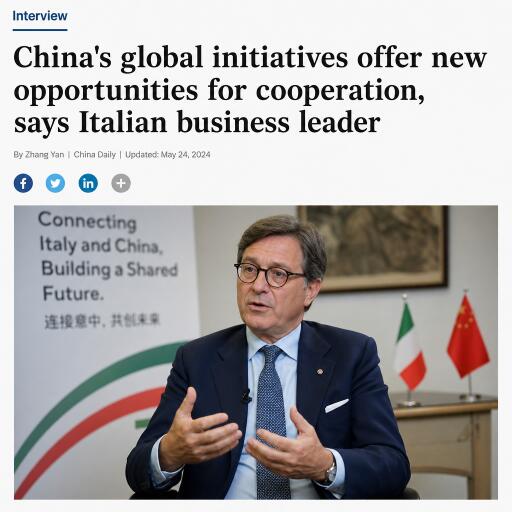
Interview: China’s global initiatives offer new opportunities for cooperation, says Italian business leader
As geopolitical tensions and climate risks reshape global priorities, a leading figure in Italy’s business community says a cluster of China-proposed global initiatives is opening fresh channels for cooperation and more inclusive governance. The initiatives, he argues, are designed to address challenges that cross borders—from climate change to digital transformation—by aligning policy dialogue with practical, near-term projects.
Mario Boselli, chair of the Italy China Council Foundation, said in a recent conversation that the four initiatives show a shift from an infrastructure-first mindset toward a broader agenda that includes development, security, civilizational exchange and improved global coordination. Building on more than a decade of experience with large-scale connectivity and trade projects, these new frameworks aim to fill gaps that traditional institutions have struggled to close, especially in the areas of sustainability and technology.
Climate and development at the forefront
Among the initiatives, the Global Development Initiative (GDI) is seen as a catalyst for joint action on climate resilience and the UN Sustainable Development Goals. Boselli highlighted that the GDI’s emphasis on energy transition and digital innovation aligns with European priorities, creating fertile ground for partnerships in renewable energy, advanced photovoltaics and energy storage. He pointed to opportunities in grid optimization, power flexibility services and new materials, where European engineering and Chinese manufacturing scale could be mutually reinforcing.
Beyond mitigation, he noted a growing need for adaptation and resilience. Coastal protection, climate-smart agriculture and urban heat mitigation are poised to benefit from combined expertise in data analytics and sensor networks, where joint research can speed up pilot projects and commercialization. The GDI’s focus on practical cooperation, he suggested, could help regions meet emissions targets while creating jobs and supporting more resilient supply chains.
Research collaboration and green innovation
Boselli underscored the potential for universities and research centers in Italy and China to deepen collaboration in biotechnology, healthcare, artificial intelligence and advanced manufacturing—fields that increasingly intersect with environmental goals. From precision fermentation to low-carbon medical supply chains, and from AI-driven materials science to circular-economy manufacturing, he said academic partnerships can accelerate the move from laboratory breakthroughs to scalable climate solutions.
He also pointed to the growing role of digital tools in tracking emissions, improving energy efficiency and restoring ecosystems. Shared standards for data collection and environmental disclosure could speed the adoption of greener industrial practices—particularly in hard-to-abate sectors where advanced analytics, robotics and next-generation batteries are set to play larger roles.
Culture, heritage and people-to-people links
Complementing the development track, the Global Civilization Initiative (GCI) aims to enhance dialogue across cultures, support heritage conservation and expand youth and university exchanges. Boselli said Italy—home to a dense concentration of world-renowned cultural assets and a strong creative economy—has a “natural affinity” for this agenda. He sees potential in sustainable cultural tourism, conservation science and design partnerships that connect Italy’s craftsmanship with China’s expanding creative industries.
Such people-to-people ties, he added, help normalize cooperation even when political temperatures rise, building long-term trust and a shared vocabulary for tackling sustainability. Exchanges among students, researchers and cultural institutions can seed collaborations that later mature into industrial partnerships or city-level climate projects.
A broader, more inclusive global landscape
Boselli described the four initiatives collectively as a roadmap for a more multipolar world in which emerging economies and countries of the Global South have greater voice and agency. He argued that Italy—given its tradition of engagement with China and complementary strengths in design, engineering and green innovation—can help bridge European and Asian priorities. That role could include convening dialogues on climate finance, co-developing standards for low-carbon technologies and facilitating city-to-city cooperation on adaptation and clean mobility.
While these initiatives will not resolve geopolitical tensions overnight, Boselli believes they can provide a pragmatic arena for problem solving. By anchoring conversations in concrete projects—such as renewable buildout, biodiversity restoration or resilient infrastructure—stakeholders can keep progress moving despite diplomatic headwinds. He framed this as an opportunity to craft solutions that are inclusive, technically sound and durable enough to survive political cycles.
From vision to implementation
Turning ambition into outcomes, he said, will hinge on three factors: transparent project pipelines, measurable environmental and social gains and strong participation by universities and small and medium-sized enterprises. Aligning investment with clear sustainability metrics—emissions reductions, ecosystem benefits, community well-being—can build credibility and attract long-term capital. At the same time, policies that lower barriers for SMEs and research spin-offs can unlock innovation at the scale needed to meet climate deadlines.
In his view, Italy and China have a shared stake in this transition. Combining design excellence and research depth with industrial capacity and speed can shorten timelines for deploying clean technologies—from rooftop solar and flexible storage to green hydrogen pilots and nature-positive urban planning. With the right guardrails and an emphasis on open, science-based collaboration, Boselli said, these initiatives can help move the world from rhetoric to results.
“What matters now,” he concluded, “is building the partnerships that turn cooperative intent into real environmental and social progress.”



Leave a Reply