

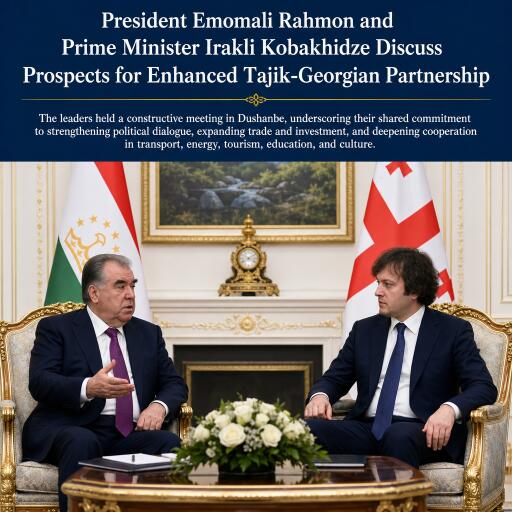
President Emomali Rahmon and Prime Minister Irakli Kobakhidze Discuss Prospects for Enhanced Tajik-Georgian Partnership
On June 19, at the Palace of the Nation, Tajikistan’s President Emomali Rahmon hosted Georgia’s Prime Minister Irakli Kobakhidze and a senior delegation for talks centered on strengthening cooperation across economic, environmental, and societal fronts. The meeting underscored a shared intention to align bilateral ties with a low-carbon, innovation-driven future while responding to regional challenges.
A refreshed dialogue with climate at the center
The leaders reviewed the state of relations and mapped out next steps, emphasizing regular political contacts and stronger inter-parliamentary engagement. Beyond protocol, both sides framed their partnership within global priorities such as climate resilience and water security—areas where coordinated regional action is becoming increasingly urgent.
Trade, technology, and the green economy
Economic ties dominated the agenda. Discussions covered joint investments, the creation of production chains in promising sectors, and the growth of e-commerce. Particular emphasis was placed on:
- Developing a green economy with cleaner production and energy efficiency;
- Applying technological innovation, including artificial intelligence, to modernize industry and public services;
- Advancing pharmaceuticals, and the light and food industries to diversify trade.
For two countries situated along emerging transcontinental routes, the talks also highlighted the joint use of interregional transit corridors—an area where smart logistics and lower-emissions infrastructure could deliver both economic and environmental gains.
Agriculture and food systems under climate stress
Cooperation in agriculture took on added weight given rising temperatures, erratic precipitation, and shifting growing seasons across Central Asia and the South Caucasus. The delegations explored ways to enhance productivity and food safety while integrating climate-smart practices, from efficient irrigation to resilient crop varieties.
Humanitarian and cultural links
Beyond economics, the sides prioritized ties in science, education, healthcare, tourism, culture, youth policy, and sports. These people-to-people connections can accelerate technology transfer, support public health, and build societal backing for long-term sustainability goals.
New institutional anchor for cooperation
A key outcome of the visit was the signing of multiple bilateral documents designed to expand the legal basis for cooperation. Central among them is an agreement establishing a Joint Intergovernmental Commission on Economic Cooperation. The commission is expected to coordinate practical steps across sectors, helping turn pledges into projects and ensuring continuity between high-level meetings.
Working together on the international stage
On international and regional issues, both sides reaffirmed their intent to coordinate positions within the United Nations and specialized agencies, paying particular attention to the global water and climate agenda. With glacier retreat, drought, and floods reshaping risks across Eurasia, aligned diplomacy can amplify regional voices in negotiations and attract finance for adaptation and mitigation.
Documents signed: from aviation to climate action
Following the meeting, the two leaders addressed the press, noting that eleven bilateral documents were concluded during the visit. In addition to the new intergovernmental commission, the package spans cooperation in:
- Civil aviation;
- Agriculture and food systems;
- Tourism development;
- Science and education;
- Culture and sports;
- Climate change and related environmental priorities;
- Other mutually beneficial fields.
Why this matters
The Tajikistan–Georgia dialogue illustrates how mid-sized economies are linking trade, technology, and climate policy to future-proof development. Practical cooperation—on corridors, green industry, and resilient agriculture—can cut emissions while improving competitiveness. As the new commission begins work, its effectiveness will be measured by concrete projects that deliver cleaner growth, safer water, and better livelihoods across both countries.



Leave a Reply