

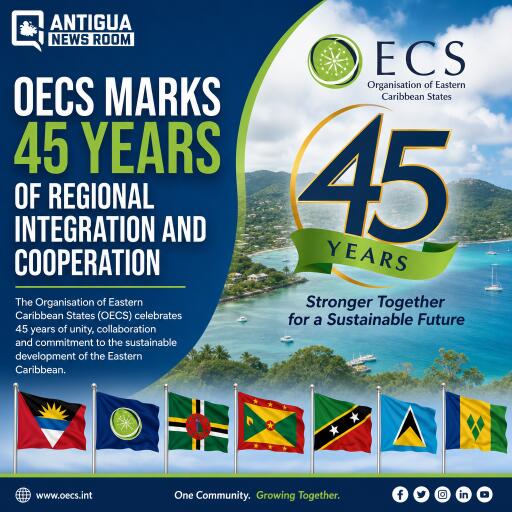
OECS Marks 45 Years of Regional Integration and Cooperation – Antigua News Room
The Organisation of Eastern Caribbean States has reached a significant milestone: 45 years of coordinated action and shared purpose under the banner “One Vision, One Voice: Navigating Challenges, Shaping Our Future.” Established on June 18, 1981, through the Treaty of Basseterre, the OECS has grown into a platform where small island states amplify their influence, pool resources, and chart collective responses to economic shifts, public health needs, security concerns, and—critically—environmental and climate threats.
A Regional Project, Four and a Half Decades in the Making
Born from a determination to work smarter together, the OECS has steadily built a framework that transforms regional ideals into day-to-day cooperation. What began as a successor arrangement to the West Indies Associated States Council of Ministers evolved into a system that synchronizes policies across education, trade, health, and foreign affairs—delivering efficiencies that individual nations would struggle to achieve alone.
For environmental resilience, that cooperation has been especially consequential. In an era defined by stronger hurricanes, intensifying droughts, and accelerating sea-level rise, the Eastern Caribbean’s shared ecosystems and interlinked economies demand cross-border solutions—from harmonized environmental standards and marine governance to coordinated disaster preparedness.
Deeper Integration, Wider Family
A pivotal turning point arrived with the Revised Treaty of Basseterre, signed in June 2010 and entering into force on January 21, 2011. This established the OECS Economic Union, sharpening the tools for integration and enabling member states to more closely align regulations and development strategies. In practical terms, it strengthened the region’s hand in negotiations, encouraged freer movement within the union, and laid groundwork for more cohesive climate and environmental policy.
The OECS has also broadened its reach beyond its original membership, expanding its circle to include Martinique in 2015 and Guadeloupe in 2019, followed by Saint Martin in March 2025. These additions underscore the shared geography and intertwined futures of Eastern Caribbean territories, where reefs, watersheds, and coastal economies do not stop at political borders. Enlarged membership brings more voices, expertise, and capacity to collective action, particularly on issues of ocean health, fisheries management, and climate adaptation finance.
One Vision, One Voice in a Warming World
The anniversary theme—“One Vision, One Voice: Navigating Challenges, Shaping Our Future”—speaks directly to the region’s climate reality. Economic uncertainty, disaster risk, and environmental degradation are converging pressures. Against that backdrop, unity is not a slogan; it’s an operating principle. Regional coordination helps member states plan for resilient infrastructure, protect biodiversity, and advocate with greater weight in international climate forums for loss-and-damage support, adaptation funding, and fair access to concessional finance.
Over 45 years, the OECS has contributed to building a common platform where science, policy, and community priorities can meet—helping to advance sustainable development pathways that recognize the Caribbean’s unique vulnerabilities and its leadership potential in renewable energy, blue economy initiatives, and nature-based solutions.
Community at the Heart of Celebration
To mark the anniversary, residents across member states are being invited to join commemorative activities and share photographs highlighting the OECS colors—yellow, white, green, and navy blue—symbols of a shared identity and future. In Antigua and Barbuda, a public fun walk is planned to bring communities together in celebration and solidarity.
These moments of public participation matter. They are reminders that integration is not only negotiated in meeting rooms or codified in treaties; it is lived every day in regional classrooms, health clinics, markets, and coastal communities. The OECS story is, at its core, a community story—one that grows stronger when citizens lend their energy, creativity, and voice.
Looking Forward
Marking 45 years is both a tribute to what has been accomplished and a prompt to move with urgency. With climate impacts accelerating, the next chapter will hinge on scaling up resilience: securing sustainable financing, protecting critical ecosystems, advancing clean energy transitions, and ensuring that development is inclusive and just. The OECS’s enduring promise lies in its ability to translate solidarity into results—aligning national priorities with a regional vision that safeguards people and nature.
As the organization looks ahead, the message is clear: by standing together, Eastern Caribbean states can better navigate uncertainty, protect their shared environment, and shape a future that is not only more prosperous, but more resilient.



Leave a Reply