

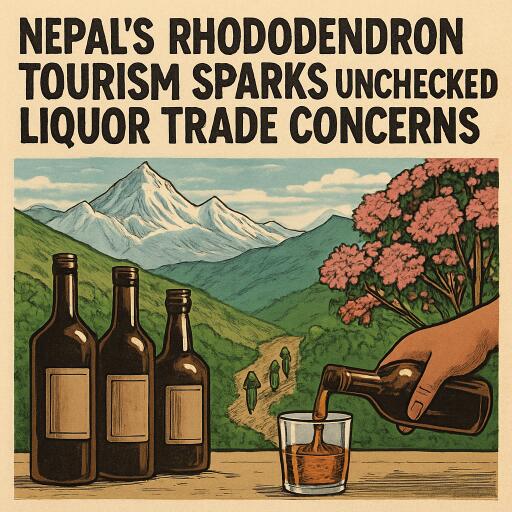
Nepal’s Rhododendron Tourism Sparks Unchecked Liquor Trade Concerns
Each spring, eastern Nepal’s hills erupt in shades of red, pink and white as rhododendrons blanket the Tinjure-Milke-Jaljale landscape. The bloom draws huge numbers of visitors to the mountain region, turning a short flowering season into a crucial economic window for hotels, tea shops and roadside vendors. But alongside the tourism boom, another trade has quietly taken root: homemade rhododendron liquor sold with little oversight.
In bazaars and stopover points across the region, bottles of flower-based alcohol are being marketed as seasonal souvenirs. Many are poured into reused soft-drink containers, some with handwritten notes, others with no proper labels at all. What is missing is not just branding, but also basic information: where the flowers came from, whether harvesting was legal, and whether the drink is safe to consume.
The issue is especially sensitive in Tinjure-Milke-Jaljale, often celebrated for its extraordinary rhododendron diversity. The region hosts at least 26 species and is one of Nepal’s best-known floral tourism destinations. It is also ecologically fragile, supporting wildlife such as red pandas, clouded leopards and snow leopards in its wider forest mosaic.
Despite long-standing forest protections, local officials appear to be navigating a legal gray area. Nepal restricts the commercial collection of rhododendrons from community forests unless permission is granted. However, when producers claim the flowers are grown in private gardens, enforcement becomes murky. Authorities are left unsure whether such products fall under forest law, food safety rules, local alcohol regulation, or informal household production traditions.
That uncertainty has allowed the trade to expand in plain view.
Shopkeepers in tourism hubs say rhododendron liquor has become an increasingly popular seasonal item, especially among domestic travelers looking for something tied to the flowering landscape. Some visitors buy it out of curiosity, assuming it is natural, local and harmless. Yet few appear to ask how it was made or whether any testing has been done.
For some households, the answer is simple: the drinks offer extra income during a short but intense tourist rush. Residents involved in small-scale production say visitors actively seek local specialties and that flower liquor helps fill a gap in earnings when few other opportunities are available. In mountain communities where tourism income is concentrated into a narrow seasonal window, even modest side businesses can make a difference.
Locals say the trade is a relatively recent phenomenon, gaining momentum only in the last few years as tourism revived after the pandemic slowdown. What may have once been occasional household use has begun shifting into a commercial product linked directly to visitor demand.
That shift is what worries conservationists. The Tinjure-Milke-Jaljale area spans a vast highland corridor and is managed largely through community forestry rather than strict protected-area status. This system gives local communities major responsibility for balancing livelihoods with conservation. But even before the liquor trade grew, rhododendrons were already under pressure from tourists who pluck blooms, snap branches for photographs and trample fragile habitats.
Community forest groups have responded with patrols, seasonal monitoring and fines for people caught picking flowers. Even so, policing tourists one by one is far easier than tracing a broader supply chain feeding commercial alcohol production. If flower harvesting for liquor is increasing, local managers say it may be happening beyond the notice of enforcement teams focused on visible visitor behavior.
Another concern is health. Not all rhododendron species are chemically identical. Some contain compounds known as grayanotoxins, which can be harmful and in rare cases dangerous. In a region where numerous species bloom side by side, identifying exactly which flowers enter homemade alcohol is difficult. Crossbreeding among varieties may further complicate the chemical picture.
Officials and sellers alike acknowledge that bottles currently circulating in tourist markets are generally not lab-tested. That means consumers have little way to know whether the product contains risky toxin levels, unsafe alcohol concentrations, contamination from unclean containers, or residues introduced during informal production. In practice, a souvenir sold as a local novelty may carry unanswered public health questions.
The problem extends beyond alcohol itself. The popularity of rhododendron tourism is growing faster than management systems designed to protect the landscape. New trekking routes and improved access could bring more visitors and more revenue, but they may also intensify waste, flower collection and pressure on mountain ecosystems already showing signs of stress.
Climate change is adding another layer of vulnerability. Local forest users report shifts in rainfall, delayed snowfall and longer dry spells, all of which affect flowering cycles. In a tourism economy built around predictable bloom timing, these changes matter not only to biodiversity but also to household livelihoods. If blossoms appear later, fade faster or become less abundant, the entire seasonal economy could be disrupted.
This leaves local governments facing a difficult question: how to support income generation from nature-based tourism without allowing an unregulated market to damage the very resource on which that income depends.
At minimum, the region’s rhododendron liquor trade highlights several urgent gaps. There is no clear tracing of flower sources, no consistent monitoring of harvest levels, no standardized testing of finished products and no dedicated framework that connects forest protection with food and alcohol safety. Without those basics, the trade risks becoming both an ecological and public health blind spot.
For now, visitors continue to arrive for the spectacle of blooming hillsides, and bottles of rhododendron liquor continue to move across shop counters as tokens of the season. But unless regulation catches up with tourism, Nepal’s celebrated spring flower may increasingly be treated less as a protected natural treasure and more as a poorly monitored commodity.



Leave a Reply