

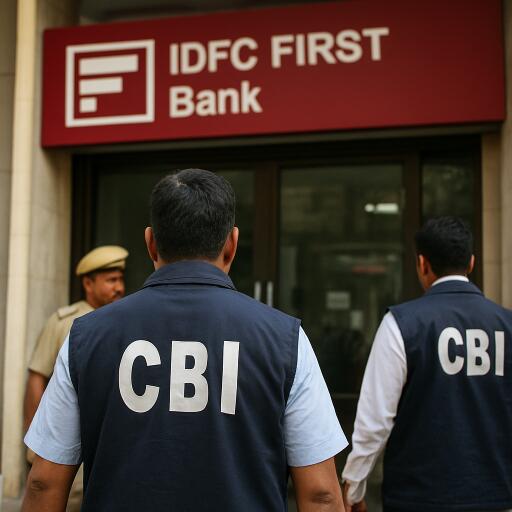
CBI Conducts Searches In Rs 661 Cr IDFC First Bank-AU Finance Bank Fraud Case
India’s Central Bureau of Investigation (CBI) has carried out coordinated searches across six locations in Chandigarh, Panchkula and the Delhi-NCR region as part of an ongoing probe into an alleged Rs 661-crore diversion of public funds. The investigation centers on suspected collusion between certain public servants, bank officials and a Noida-based consultancy that allegedly enabled the opening of bank accounts, transfer of government money and its subsequent misappropriation.
Scope of the alleged fraud
According to the investigation, funds originating from multiple departments of the Haryana government and the Union Territory of Chandigarh were allegedly siphoned off after being parked with IDFC First Bank and AU Finance Bank. The suspected diversion is said to have affected eight departments in Haryana and two in Chandigarh—the Municipal Corporation Chandigarh and the Chandigarh Renewable Energy and Science and Technology Promotion Society (CREST).
Investigators say documentary and digital evidence indicates a pattern: accounts were opened and operated in a manner that facilitated the movement of public money away from authorized purposes. The probe suggests that certain officials, entrusted with safeguarding public finances, may have accepted improper benefits while overlooking or enabling irregular transactions.
Raids and key entities under scrutiny
The searches—conducted on Friday—targeted premises linked to senior public servants from the Haryana cadre as well as Noida-based Vipam Consultancy Pvt Ltd and its director. Preliminary findings indicate that the consultancy allegedly received proceeds of crime into its account, which were later transferred to the personal account of its director.
During the operations, the agency seized a range of materials, including digital devices, property records and other documents believed to be relevant to the alleged scheme. These materials are expected to inform the next phase of analysis, including potential forensic examination of financial flows and communications.
Why this matters for public services and clean energy
Beyond the immediate financial dimension, the case raises broader concerns about public trust and service delivery. The Municipal Corporation Chandigarh plays a central role in urban services, while CREST advances renewable energy and science-led initiatives across the city. Any misdirection of funds earmarked for these entities could delay municipal improvements or stall clean-energy programs—such as rooftop solar, public lighting efficiency or research and pilot projects—that are critical to cutting emissions, lowering energy bills and strengthening climate resilience.
When resources designated for sustainability and innovation are compromised, the impacts are not just fiscal; they can ripple out into slower project timelines, lost momentum for energy transition efforts and reduced capacity to meet local climate and development goals. Safeguarding public finance mechanisms is therefore essential to maintaining continuity in municipal services and renewable energy programs.
What investigators say they found
- Evidence pointing to coordination between certain public servants and bank officials to set up and operate accounts used for unauthorized transfers.
- Alleged acceptance of undue advantages by some officials in exchange for facilitating questionable transactions or ignoring irregularities.
- Movement of suspected proceeds of crime through a consultancy’s bank account and then into the personal account of its director.
- Seizure of incriminating documents, digital media and property-related records during the search operations.
The road ahead
The CBI’s inquiry is ongoing. With documents and digital evidence now in hand, investigators are expected to reconstruct the transaction trail to determine how public funds were routed, who authorized specific movements and where accountability lies within the chain of decision-making. Depending on findings, the case could widen to include additional officials or financial intermediaries, and may trigger enhanced oversight measures for government accounts managed through commercial banks.
For departments tasked with delivering essential services and scaling up renewable energy, the immediate priority will be insulating program budgets and project timelines from any disruption. Ensuring strict compliance protocols, real-time audit trails and stronger bank-government controls can help prevent similar vulnerabilities and keep public investments aligned with their intended social and environmental outcomes.



Leave a Reply