

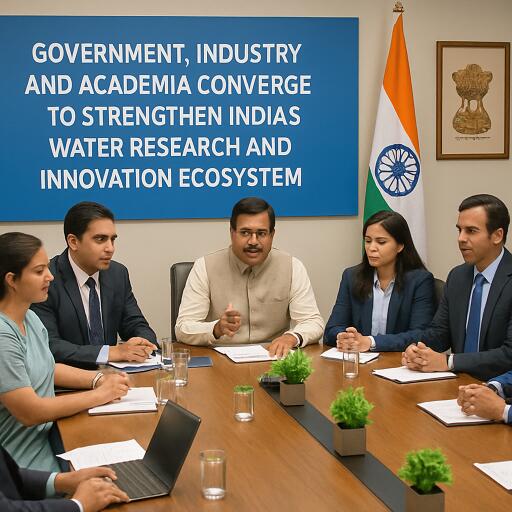
Government, industry and academia converge to strengthen India’s water research and innovation ecosystem
India is preparing for a high-level push to modernize its water research and innovation landscape, bringing together policymakers, scientists, industry leaders, startups and community stakeholders in a coordinated effort to improve long-term water security.
The one-day workshop is designed to deepen cooperation across government departments, academic institutions and the private sector, with a focus on turning research into practical solutions for water management. The broader goal is to align science, policy and local action at a time when the country faces growing pressure from climate variability, groundwater depletion, urban demand and the need for more efficient irrigation.
A central announcement at the event will be the launch of MAHA on Water — the Mission for Advancement in High-Impact Areas for Water. This joint programme is intended to accelerate advanced research in strategic fields including water resources planning, safe drinking water, climate resilience and improved water-use efficiency. A fresh call for research proposals is also set to be opened, inviting institutions and experts to contribute solutions in these priority areas.
Another major step will target entrepreneurship in the sector. Authorities are expected to open a new call for startups and MSMEs through the BHARAT-WIN Portal, aimed at encouraging the development of new products, tools and prototypes for water-related challenges. The move reflects a growing emphasis on commercializing innovation and helping smaller firms test technologies that could support monitoring, conservation, treatment and distribution.
Community participation will also form a key pillar of the initiative. A digital platform called Jal Sanchay Jan Bhagidari: Catch the Rain is set to be introduced to encourage citizens, institutions and local bodies to record and share their efforts in rainwater harvesting, groundwater recharge and water conservation. The platform is expected to amplify local engagement while promoting behavior change and grassroots innovation as essential parts of a broader water resilience strategy.
In parallel, space technology is poised to play a larger role in water governance. A new agreement between the Ministry of Jal Shakti and ISRO is expected to expand the use of satellite-based tools and advanced analytics for water assessment, tracking and planning. Officials have already identified two dozen priority studies and cooperation areas, signaling a stronger integration of Earth observation data into decision-making around rivers, aquifers, floodplains and storage systems.
The workshop agenda includes technical discussions on a wide range of pressing issues: groundwater management, irrigation efficiency, river behavior, floodplain mapping, climate adaptation, ecological evaluation, dam safety, hydraulic infrastructure, urban aquifer studies and the use of remote sensing for smarter governance. These sessions are expected to help bridge the gap between research findings and field-level implementation.
Participants will also review the results of water-sector research carried out over the past 12 years. Researchers and end users are expected to present case studies, lessons learned and measurable outcomes from interventions already deployed on the ground. This retrospective assessment will help shape future investment priorities and guide planning for the next public finance cycle.
Alongside the policy and technical sessions, the event will host an exhibition of emerging technologies, research成果, and operational best practices in the water sector. The showcase is meant to give research centers, technical institutions, startups and small businesses a venue to demonstrate solutions that could strengthen sustainable and technology-enabled water management across India.
The gathering represents more than a routine policy meeting. It signals a growing recognition that water stress can no longer be addressed by government action alone. Effective solutions will depend on a deeper alliance between science, technology, entrepreneurship and citizen participation.
If the initiatives announced at the workshop translate into sustained funding, stronger data sharing and broader institutional coordination, they could help build a more resilient national water ecosystem — one better equipped to respond to climate risks, support development and protect vital resources for the future.



Leave a Reply