

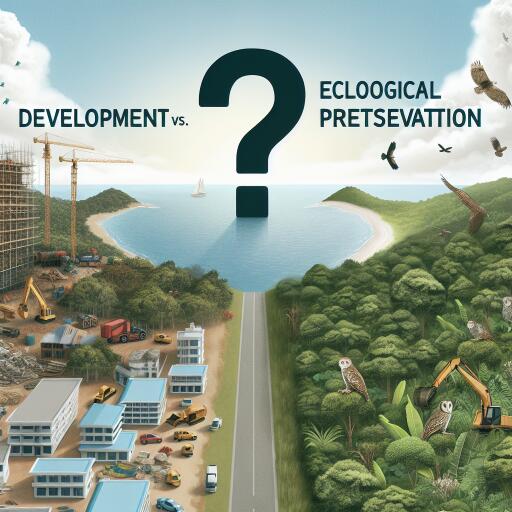
NGT Clears Great Nicobar Project: Development vs. Ecological Preservation
The National Green Tribunal has allowed the Great Nicobar Island mega-development to proceed, concluding that the mitigation measures attached to its 2022 environmental clearance are sufficient to address identified gaps. Issued on February 16 after months of reserved judgment, the order leans heavily on the project’s strategic value even as critics warn of irreversible ecological damage and geological risk in one of India’s most sensitive island ecosystems.
What the tribunal decided
The tribunal declined to halt work on the project and endorsed the earlier environmental clearance, noting the “strategic importance” of the development. The decision follows two rounds of litigation that began in 2022, when petitioners highlighted lacunae in coastal regulation compliance under the Island Coastal Regulation Zone rules. In response, the tribunal had directed a High-Powered Committee (HPC) to re-examine specific shortcomings before reaching its final view.
A megaproject in a fragile archipelago
- Estimated investment: ₹81,000 crore.
- Key components: an international container trans-shipment port at Galathea Bay, a greenfield airport, a gas and solar power plant, and a new township.
- Strategic rationale: positioning along the Malacca Strait to bolster trade capacity and maritime security.
Forests, turtles and reefs at stake
Great Nicobar’s tropical rainforest—most of it inside the Great Nicobar Biosphere Reserve—anchors hydrological cycles and hosts high levels of endemism. Project plans envisage the felling of roughly one million trees, a scale ecologists say cannot be offset by compensatory plantations on the Indian mainland. The proposed site in Galathea Bay overlaps with nesting habitat of the globally endangered leatherback turtle, making the coastline particularly sensitive to light, noise, dredging, and shoreline modification.
Underwater, coral communities are also at risk. Authorities have suggested translocating scattered corals from the port footprint, and an official assessment has contended that no extensive reefs occur at the exact site. Marine scientists counter that relocation success is uncertain—especially as warming seas and bleaching events heighten stress—making survival rates questionable and ecological recovery far from guaranteed.
Regulatory grey zones and secrecy
The HPC, comprising representatives from key government bodies, reported no fundamental flaws in the clearance. However, its report has not been made public, with officials citing national security. That opacity has amplified concerns about how competing datasets were reconciled—particularly on whether portions of the footprint fall within the most restrictive coastal category (CRZ 1A). Earlier administrative maps and conservation plans flagged high-sensitivity zones, while subsequent ground-truthing used by the HPC arrived at a different conclusion. Petitioners also challenged the adequacy of relying on single-season baseline data for a project of this magnitude.
Shifting ground: seismic and climate hazards
The island lies along the seismically active Sumatra–Andaman subduction zone, where land levels change through cycles of slow uplift and sudden subsidence. The 2004 megathrust earthquake caused Great Nicobar to drop by roughly three to four metres in a matter of minutes. Such dynamics place long-lived coastal infrastructure—ports, runways, and sea-facing townships—at continual risk. Coupled with rising seas, storm surges, and intensifying rainfall, the margin for error narrows: even well-engineered structures may face design exceedances, accelerated fatigue, and soaring maintenance costs across their lifetimes.
Communities and consent
Indigenous communities—the Shompen and Nicobari—have inhabited Great Nicobar for millennia. Observers argue that the project has advanced without demonstrable free, prior, and informed consent, raising serious questions about compliance with legal protections and the safeguarding of cultural landscapes. For populations already vulnerable to displacement and disaster, the compounded threats from earthquakes, coastal change, and rapid urbanization are not abstract—they are existential.
Economics and strategy
Supporters of the project present it as a lever for national logistics capacity and a hedge against regional geopolitical pressure. They point to the proximity to vital shipping lanes and potential gains in cargo trans-shipment. Skeptics counter that the business case remains unproven, warning that environmental externalities and disaster risks could undermine returns and turn public investment into stranded assets. They also draw comparisons to past infrastructure pushed through on security grounds in fragile geographies, cautioning that short-term wins can seed long-term instability.
The climate-ecology paradox
India has articulated ambitious environmental commitments, from biodiversity stewardship to climate action. Great Nicobar now crystallizes a central paradox: can a maritime strategy predicated on a mega-port, new city, and heavy coastal modification coexist with ecological limits on a tectonically restless island? Proponents emphasize layered safeguards; environmentalists argue that in living systems already stressed by warming, some losses cannot be engineered away.
What to watch next
- Transparency: whether key assessments and monitoring data—especially on turtles and corals—become publicly accessible.
- Mitigation quality: the scientific rigor of coral relocation, light/noise management for nesting beaches, and biodiversity offsets.
- Forests and water: how large-scale clearing affects rainfall patterns, freshwater security, and disaster risk.
- Disaster readiness: integration of seismic design, tsunami evacuation planning, and climate adaptation into project phasing.
- Community rights: clear, verifiable processes that uphold consent and safeguard livelihoods and cultural integrity.
The NGT’s green light does not end the story; it shifts it to the ground, where implementation, independent oversight, and the island’s own volatile geology will ultimately judge whether this vision of progress is resilient—or irretrievable.



Leave a Reply